Wenlock Cellars
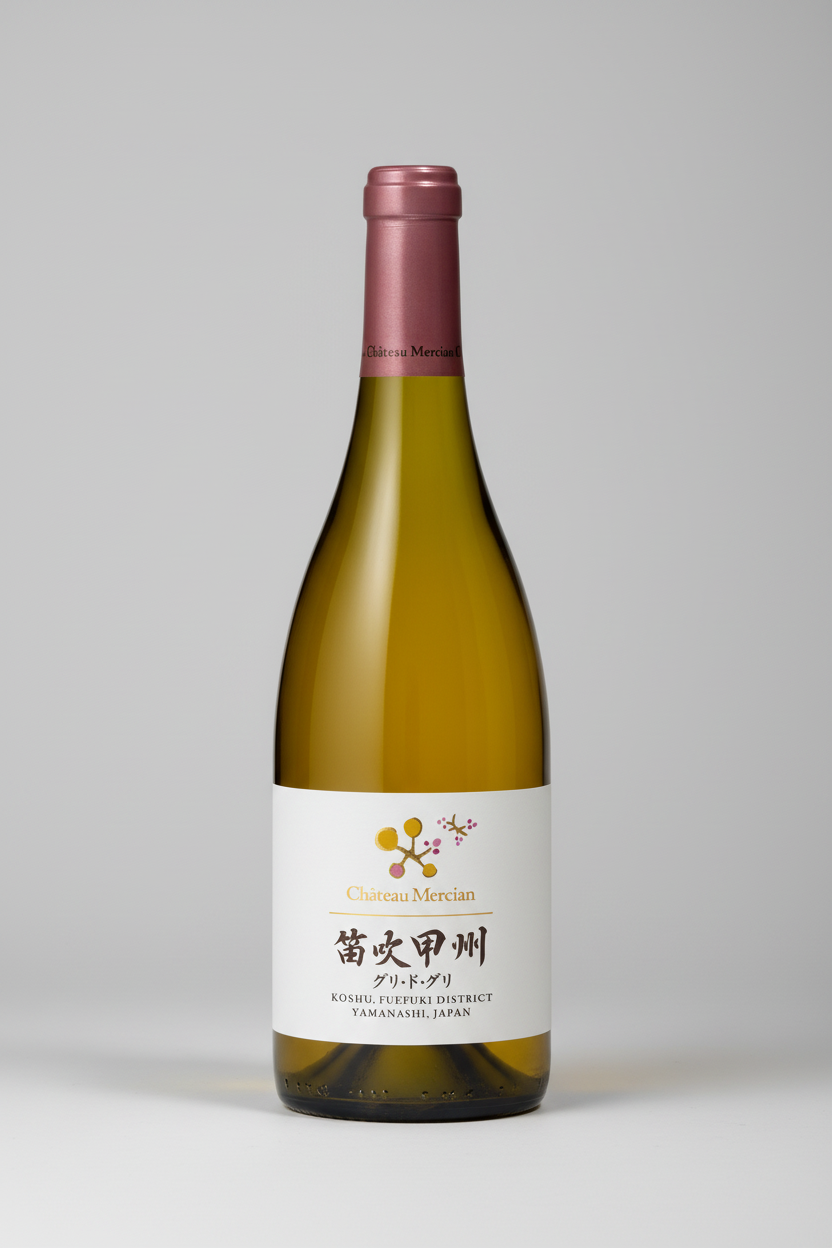
Château Mercian Koshu Gris de Gris, Fuefuki 2022
Château Mercian Koshu Gris de Gris, Fuefuki 2022
Couldn't load pickup availability
Production
Koshu grapes are grown in the Fuefuki district, one of the 13 cities located in Yamanashi Prefecture. Harvest takes place from late September to early October. Grapes are destemmed and crushed and the juice is divided into three cuvee's, the first portion spends four weeks with skin contact in a stainless tank, the second, two weeks with skin contact in a wooden vat and the third has two hours of Themo maceration and cooling down overnight with skin contact. The three wines are then blended and aged in oak barrels for 8 months.
Tasting notes
Faint reddish orange hue. Sweet and gentle aromas of apricot, candied pear, Darjeeling and old Rose with subtle vanilla notes derived from 8 months in oak barrels. The complex palate from the skins and seeds of the Koshu grape come from gentle skin contact, this creates a three-dimensional feeling in the mouth.
Food match
Matches well with asian dishes, asparagus risotto or stony river fish.
Awards
2021 Vintage
International Wine Challenge 2023
Bronze
International Wine and Spirit Competition 2023
Silver
2020 Vintage
International Wine Challenge 2022
Silver

Meet the Producer
As grapes were never indigenous to Japan all grapevines had been introduced to the region with the movement of the spice route and silk roads over 2,000 years. It is believed that about 1,300 years ago grapevines were introduced to Japan where the climate was too hot, cold, wet – too extreme – to grow grapes for wine.
Ultimately the existing grape variety most successfully grown in Japan became known as Koshu, which was the then name for the prefecture in which it grew. This prefecture then took the name of a Japanese prince and became Yamanashi, which remains the principal region producing Koshu. Responsible today for 40% of all Japanese grown wine grapes, it is believed to be the naturalised hybrid of a Georgian grape variety. Ampelographers continue to isolate the DNA of Koshu, but we do not actually know, outright, its source. What we do know is that it is a lurid pink on the vine, generally grown in the local tana method (overhead bamboo trellis).
Château Mercian grows Chardonnay, Merlot, Syrah, Cabernet Franc and Petit Verdot, whilst experimenting with Albarino, Mencia and others, and has always shared its long experience of producing wine in Japan with every other producer in the region. Château Mercian is the oldest established winery in Japan, starting out in 1870 having sent two young men to France to understand wine making in the European tradition. Indeed the descendants of these two men are still growing Koshu for Mercian today.
Koshu, like many things Japanese, is all about subtlety of flavour, texture and the wine being part of a greater organoleptic experience than the wine itself, so imagine drinking this with a slurpy bowl of hot yum from a chilly noodle shop in the hills. It's part of the whole, not the whole, therefore the fruit is not overt, it's more about texture, acidity and finish rather than outright fruit flavour.
A Note on Sustainability
From the very beginning of Japanese wine making, Château Mercian has continuously taken on the challenge of introducing new cultivation methods and vinification techniques, sharing new methods with other wineries, contributing to the development of Japanese wine and raising the standard of the Japanese wine industry. Chateau Mercian aim to revitalise grape production areas through developing people and unused land, creating jobs and providing an environment where rare plant species can make a comeback. Local children are given the opportunity to experience agriculture in the vineyards to ensure that wine making techniques will continue and be passed on to the next generation.
In 2005, Château Mercian’s owner, the Kirin Group, announced its participation in the United Nations Global Compact, a voluntary global initiative for companies committed to exercising creative leadership for maintaining responsible business practices and sustainability. Kirin has formulated a CSV (Creating Shared Value) Purpose - a guideline of long-term, non-financial goals that promote sustainable growth. It has highlighted its duty to be a responsible alcohol producer, as well as the themes of health and well-being, community engagement, and the environment as key social issues.